The Offbeat Sari: Contemporary Indian Fashion Exhibition in Melbourne
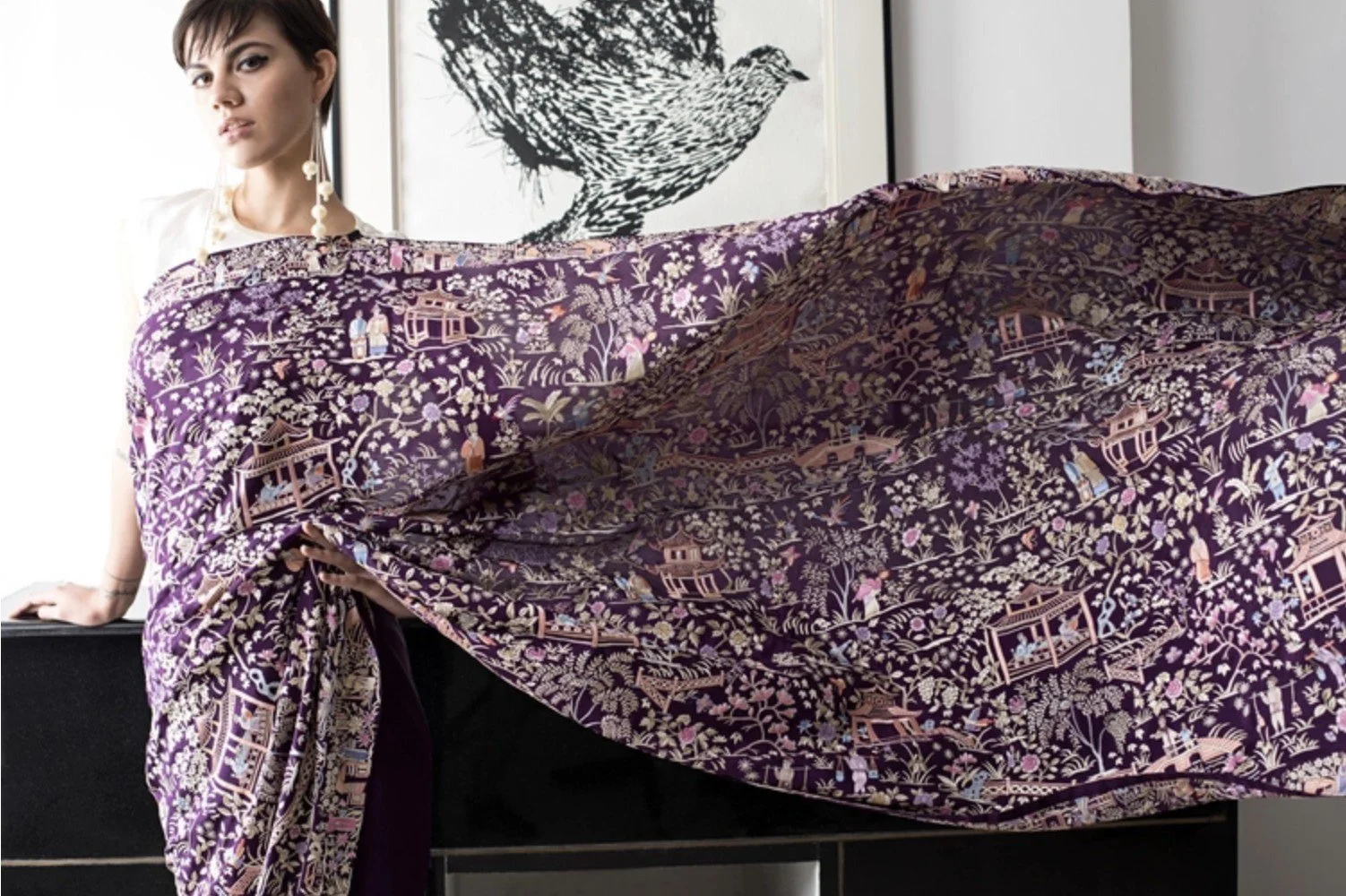
China town sari from the Chinoi-sari collection, 2017. Ashdeen. Photo Hormis Antony Tharakan

Sabyasachi’s gold tulle creation with a Schiaparelli bodice, worn at the Met Gala 2022
When a sari is woven from stainless steel instead of silk, it signals more than material experimentation: it marks the garment’s place in contemporary design. That tension between tradition and invention lies at the heart of The Offbeat Sari, the touring exhibition arriving in Melbourne next year, offering a view of the sari as both a cultural icon and a field of ongoing experimentation.
First shown at London’s Design Museum in 2023, the exhibition focuses on the sari as it is being made and worn today, highlighting designers who are rethinking its form, structure, and purpose. Rimzim Dadu’s stainless steel sari and Diksha Khanna’s distressed denim drape test what a sari can be, while Sabyasachi’s gold tulle creation with a Schiaparelli bodice, worn by Natasha Poonawalla to the Met Gala, demonstrates how the sari can carry the weight of couture visibility without losing its Indian identity.
The exhibition unfolds in three sections. Transformations tracks the ways designers are expanding the sari’s boundaries: stitched constructions, pre-draped forms, and playful experiments that treat the fabric as a surface for invention. Identity and Resistance shifts focus to the wearer, presenting examples from urban street style to activist dress, showing how the sari communicates individuality, agency, and intent. New Materialities examines the cloth itself — the textures, weaves, and techniques that designers and craftspeople are adapting to contemporary materials and unexpected finishes.
The sari has always been flexible. Its single, unstitched length allows climate, region, social setting, and purpose to shape how it is draped and worn. What this exhibition highlights is the acceleration of that adaptability: designers now introduce industrial fibres, hybrid silhouettes, and sculptural surfaces, while wearers are making it part of everyday life, pairing saris with sneakers, shirts, and minimal accessories. In this context, innovation is less about novelty and more about how the garment functions in real-world, urban life.
The exhibition also presents the range of contemporary sari design in India. Abraham & Thakore focus on subtle pattern and tactile complexity; Raw Mango and NorBlackNorWhite explore graphic, conceptual references; Amit Aggarwal, HUEMN, and Bodice prioritise material manipulation and structural experimentation. Couture pieces from Tarun Tahiliani or Abu Jani Sandeep Khosla provide a point of contrast, showing the sari’s capacity for extravagance alongside practicality.
The Offbeat Sari is less an archive than a living narrative. It demonstrates how a garment can evolve while remaining recognisable, how designers and wearers continue to challenge assumptions, and how materials, form, and everyday wear can intersect. The exhibition confirms that the sari is not a relic to be preserved, but a framework for invention, and a lens through which contemporary Indian design can be understood and appreciated today.
The exhibition will run Mar 21 – Aug 30, 2026 at Bunjil Place Gallery