Keysook Geum: When fashion becomes sculpture
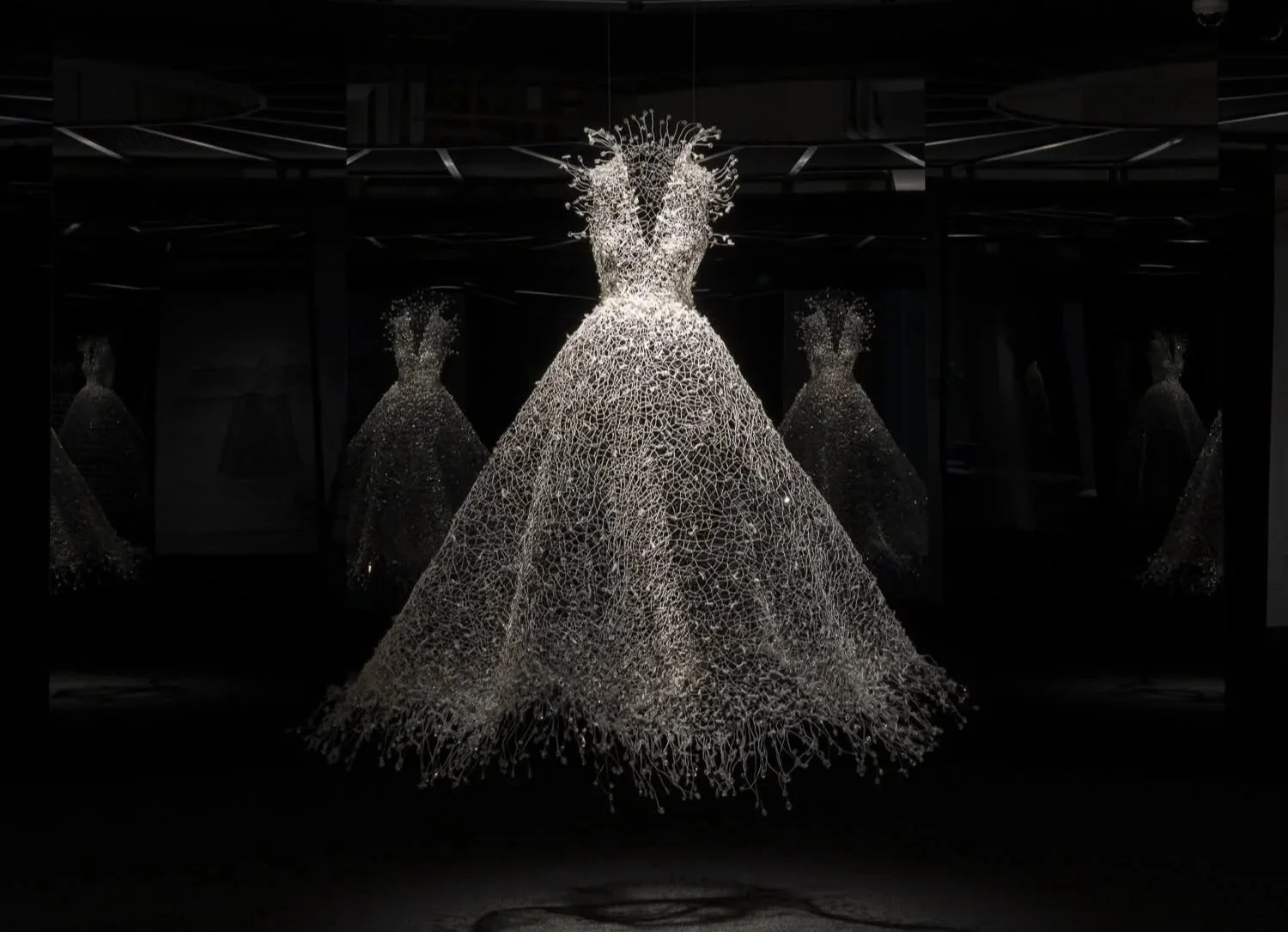
At first glance, the Snow Fairy dress appears almost weightless — a pale apparition suspended between fabric and air. Created for the placard bearers at the opening ceremony of the 2018 PyeongChang Winter Olympics, the dress embodies Keysook Geum’s signature restraint: translucent layers, an ethereal palette, and a silhouette that hovers rather than clings. On the body, it moved like breath in cold air; off the body, now on view at the Seoul Museum of Craft Art, it asserts itself as sculpture rather than costume.
Within Geum’s body of work, the Snow Fairy dress feels like a crystallisation of her ideas. It condenses her long-standing investigation into lightness, negative space and movement — concerns that have shaped her practice since the early 1990s. Though it appeared to global television audiences as a moment of Olympic spectacle, the dress carries Geum’s signature: a language of lightness, rhythm, and structure that marks it unmistakably hers.
The dress anchors Dancing, Dreaming, Enlightening, a major exhibition at the Seoul Museum of Craft Art, running through March 15, 2026. Part retrospective, part cartography, the exhibition traces Geum’s evolution from fashion designer to a defining figure in fashion art through 56 works spanning nearly forty years.
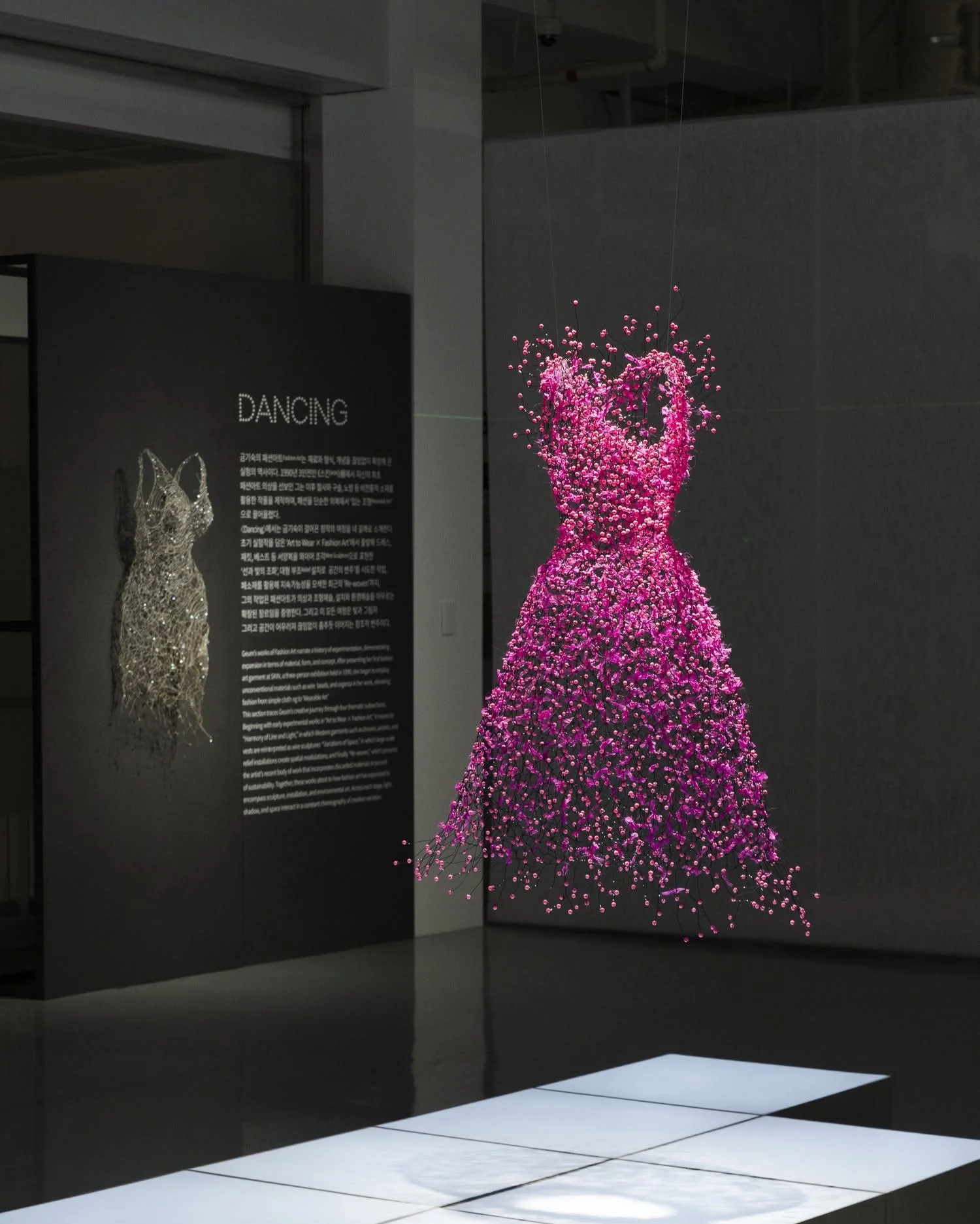
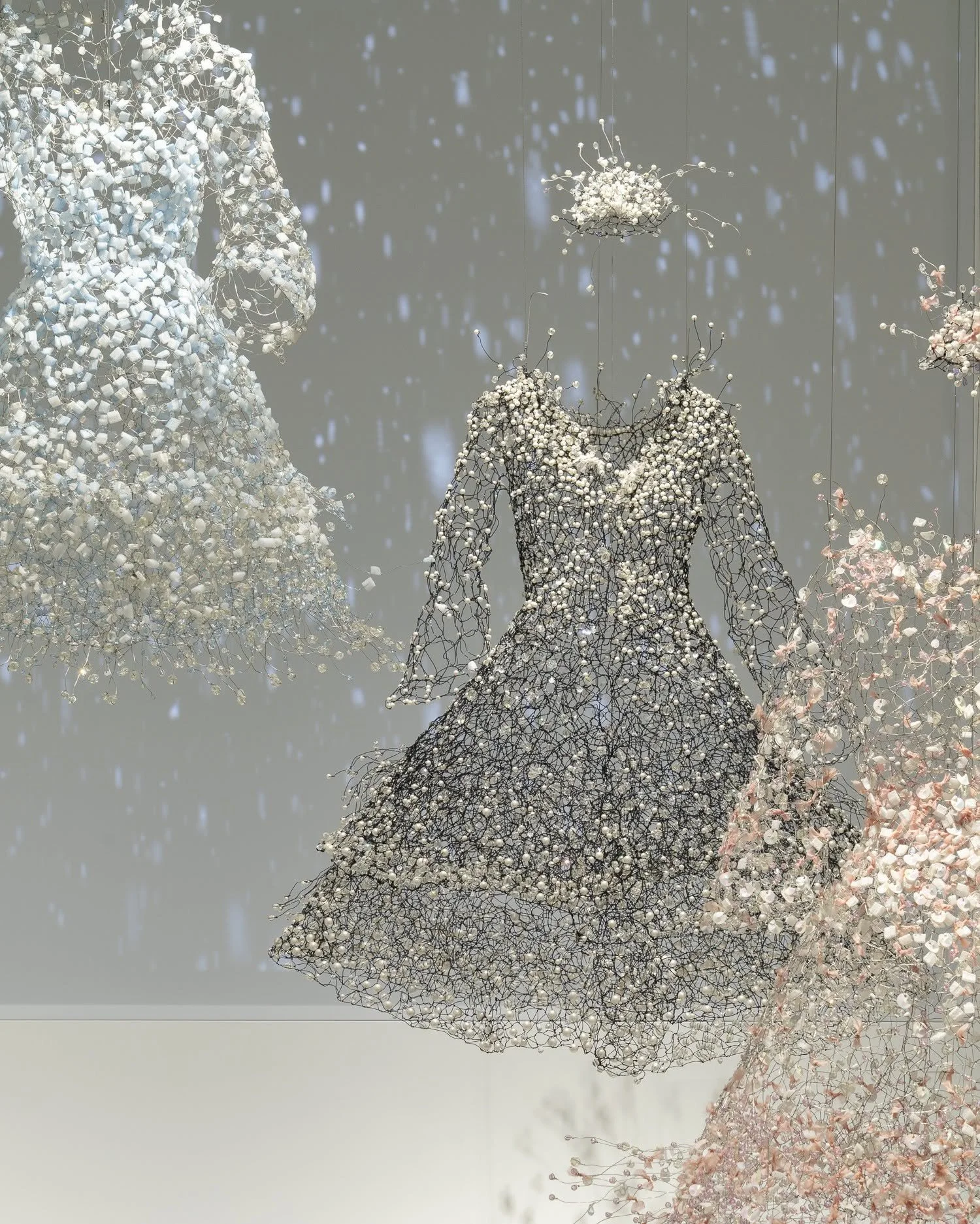
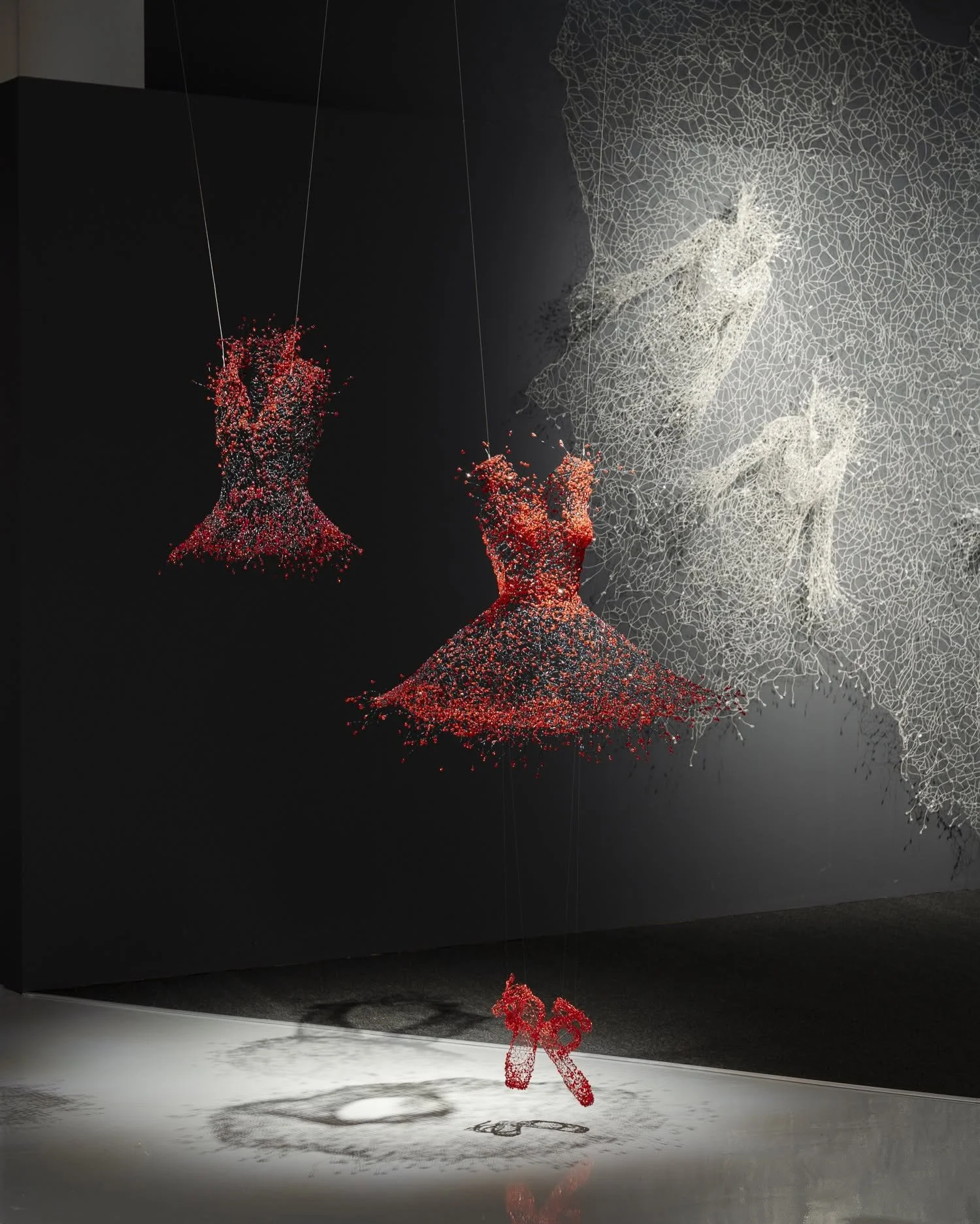
Trained in textiles and fashion design, Keum spent years teaching and working within the industry, before pivoting in the early 1990s to treat clothing not as an end point but as a structure for exploring line, transparency, and space.
Her early memories — threading flowers as a child in Pyeongchang — surface repeatedly in her work. These sensibilities later crystallised in her use of unconventional materials: wire replacing seams, beads standing in for embroidery, ramie and sequins treated as structural rather than decorative elements. From this emerged a practice positioned between fashion, sculpture and performance—a hybrid field she would later help define as founding president of the International Fashion Art Federation.
That shift is visible from room to room. Early works still acknowledge the body, garments hovering close to wearability while quietly resisting function. As the exhibition unfolds, clothing gives way to autonomous form: wire dresses and beaded jackets that register as drawings in space. One section is devoted to her reinterpretation of the hanbok, where she abstracts its formal logic — isolating the curve of a sleeve, the discipline of proportion — and reassembles these elements into contemporary sculptural works.
Archival material — sketches, notes, stitch studies — reveals the research-driven nature of her practice. Over time, her work has expanded beyond garments into performance, stage costume and architectural installation. Later pieces, designed for cruise ships and large interior spaces, make it clear that the body is no longer required; fashion becomes environment.
Dancing, Dreaming, Enlightening makes clear that what appears effortless is the result of intense care — every floating wire, every bead, every curve shaped with precision and thought.