When Dress Meant Power: A Paris Exhibition Explores the Secrets of 18th-Century Fashion

Attribué à Louis-Lié Périn-Salbreux (1753-1817) Portrait présumé de Marie-Thérèse de Savoie, vers 1776, Paris, Musée Cognacq-Jay
There was a particular kind of intelligence embedded in the way an 18th-century French woman dressed. The choice of fabric, the embroidery details, the exact cut of a bodice — none of it was accidental. Dress was a strategy as much as adornment. It was social language, and often social power.
That idea lies at the heart of Révéler le Féminin. Fashion and Appearances in the 18th Century, opening on 25 March 2026 at the Musée Cognacq-Jay. Produced in collaboration with the Palais Galliera, the exhibition brings together portraits, galant scenes and surviving garments to examine how femininity was constructed and displayed in Enlightenment-era France — and why those visual codes still resonate today.
The story begins with the central tension of the period. By the mid-18th century, French fashion had become the dominant language of elegance across Europe, adopted by courts from Vienna to St Petersburg. Yet within France itself, clothing had become a genuine social battleground. The rising bourgeoisie used dress to narrow the visual distance between themselves and the nobility; the aristocracy responded by refining its own codes of display.
In this climate, a gown carried almost as much symbolic weight as a formal title. Jean-Marc Nattier’s portraits of the daughters of Louis XV provide a striking example of this visual politics, balancing idealisation with sumptuous detail. Commissioned portraits of this kind were carefully calibrated images of royal magnificence — and of dynastic authority.
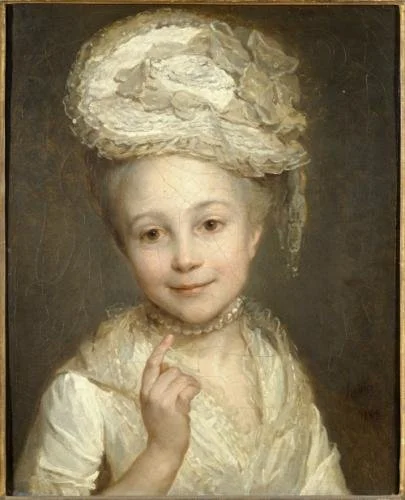
Emilie Vernet by Nicolas-Bernard Lépicié, 1769
The exhibition will look closely at the portraitists themselves, whose brush transformed fashion into a language of prestige. Amongst them, Adélaïde Labille-Guiard, the daughter of a luxury goods merchant, brought an instinctive understanding of fabric and ornament to her portraits, while Élisabeth Vigée Le Brun, trained initially under a fan painter, developed a painterly sensitivity to decorative detail and feminine grace. Meanwhile, Antoine Vestier, shaped by the discipline of miniature painting, rendered textiles with striking precision. Under their brushes, clothing becomes more than embellishment — it becomes a language of prestige.
By the 1770s, however, the visual tone begins to shift. The ideas of Jean-Jacques Rousseau, with their emphasis on nature and authenticity, began to reshape ideals of femininity. White cottons and muslins — fabrics associated with domestic intimacy — gradually displaced the rigid splendour of brocades. Portraits of women and children adopted a softer mood, influenced by the relaxed naturalism of English painting.
Fashion, the exhibition suggests, has always been responsive to ideas. What women wore reflected not only social rank but the intellectual currents of their time.

CHANEL’s SS 2019
Another section explores the fêtes galantes painted by Antoine Watteau and Nicolas Lancret, along with the pastoral fantasies of François Boucher. In these scenes, aristocrats and bourgeois alike appear dressed as shepherdesses or characters from the Commedia dell’arte. Masked balls and pastoral fêtes allowed society to play with costume and identity — a sophisticated cultural game that painters both documented and embellished.
The exhibition will close with a contemporary counterpoint. Photographs by Steven Meisel, Esther Ségal and Valérie Belin are placed in dialogue with a haute couture creation by Karl Lagerfeld for Chanel’s Spring–Summer 2019 collection — a gown scattered with hand-painted, three-dimensional floral embroideries in foam and ceramic powder.
The comparison spans more than two centuries, yet the underlying logic is continuous. Whether navigating court society or a fashion shoot, women have always understood that a dress can construct an image of femininity — shaped by cultural expectations as much as personal expression. The silhouettes have changed, yet the central idea has not: clothing remains one of the most sophisticated visual languages through which women present themselves to the world.
Révéler le Féminin. Fashion and Appearances in the 18th Century runs at the Musée Cognacq-Jay, Paris, from 25 March to 20 September 2026