The Woman Who Made Fashion Disappear — and That Was the Point
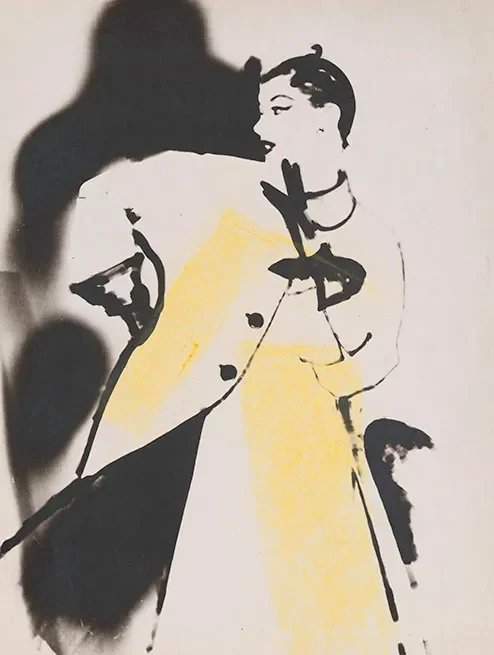
Lillian Bassman (American, 1917–2012). Variant of The Yellow Smock Coat, 1950. Gelatin silver print. 13 1/4 × 10 1/2 in. (33.7 × 26.7 cm). The Metropolitan Museum of Art, New York, Gift of Lizzie and Eric Himmel, 2025 (2025.889.22)
© Estate of Lillian Bassman
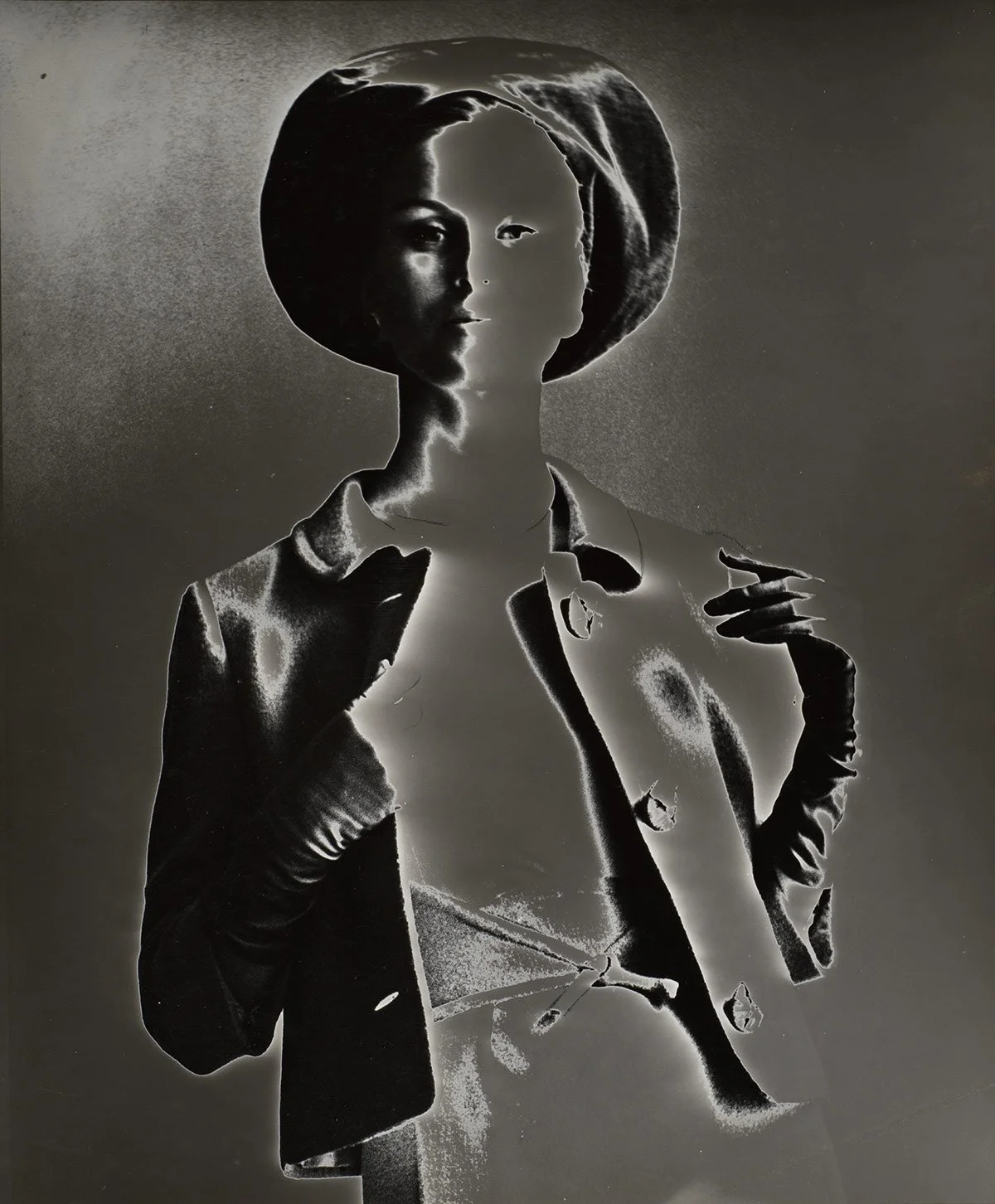
Lillian Bassman. Solarized Fashion Study, ca. 1960. Gelatin silver print. The Metropolitan Museum of Art, New York, Gift of Lizzie and Eric Himmel © Estate of Lillian Bassman
There is a fashion photograph of a yellow coat by Lillian Bassman in which the garment is almost beside the point. The Yellow Smock Coat, ca 1950, gives you a slash of yellow, the suggestion of buttons, and a silhouette in profile. A shadow looms in from the left, dark and almost predatory, pressing against the model as if the image itself might swallow her. The garment, technically the subject of the photograph, barely holds its ground. And yet you feel it completely.
That tension between showing and withholding — between the document and the sensation — is where Bassman lived, and where no one else in mid-century fashion photography quite followed her. In 1950, her editors at Harper’s Bazaar reportedly told her this kind of work was dangerous. She kept doing it anyway.
Born in Brooklyn in 1917 to Russian-Jewish émigré intellectuals with decidedly bohemian leanings, Lillian Bassman came of age in downtown New York during the Depression, posing as a nude model for the Art Students League of New York and assisting on murals for the Works Progress Administration. Fashion, in the conventional sense, was not her world — and that distance, ultimately, is what made her so good at photographing it.
Her path into the industry began not with a camera but with a drafting pen. She trained as a textile designer and fashion illustrator before a pivotal encounter with Alexey Brodovitch, the visionary Russian art director at Harper’s Bazaar, changed her trajectory entirely. Brodovitch offered her a scholarship to study at the New School for Social Research, then brought her on as his first salaried assistant at the magazine. Under his influence — steeped in Surrealism, Bauhaus precision, and Constructivist cool — Bassman helped reimagine what an American fashion magazine could look like on the page.
Her most formative independent work came through Junior Bazaar, the Hearst teen spinoff she ran as art director from 1945. During her tenure there, she handed early assignments to photographers who would go on to define the era — Richard Avedon and Robert Frank among them. When funding dried up and the publication folded, Bassman picked up the camera and turned it on the world she had spent years editing.
What she produced over the next two decades was unlike anything her contemporaries were doing. Her models rarely looked directly into the camera; poses were unconventional, gestures often obscured the face entirely — and yet the images never felt cold or withholding. By stripping away the documentary literalism of straight fashion photography, Bassman got closer to the feeling of wearing something beautiful than most sharp-focus images ever managed. She wanted to capture the curves and flow of the female body, the sensuality that illustration had always allowed her — and she found a way to do exactly that through the photographic print.
Her muse throughout this period was model Barbara Mullen, whose long-limbed elegance lent itself perfectly to Bassman’s vision — a body reduced to line, gesture and movement rather than fashion detail.
By the 1970s, shifting tastes had made her approach feel out of step, and she stepped back from the industry — at one point destroying a significant number of her own negatives.
The second act came in the 1990s, when bags of negatives Bassman had once discarded were rediscovered in her own home and a new generation of editors and art directors suddenly recognised what had been there all along. Bassman returned to the darkroom — and later, to Photoshop, which she embraced without sentimentality — and began reprinting her old work in an even more abstracted style. The fashion world caught up with her once again.
Lillian Bassman: Bazaar and Beyond presents over 60 works — vintage prints, collages, layout maquettes, and rare publications — drawn primarily from a new gift of 70 pieces from her estate. Bassman often credited her time in museum galleries with shaping her eye: by studying centuries of drapery and movement in the old masters, she learned to see clothing not just as garment but as gesture, a principle that would define her photographic vision.
Lillian Bassman: Bazaar and Beyond is on view through July 26, 2026, at The Met Fifth Avenue, New York.