Joana Vasconcelos and Valentino: An Exhibition in Dialogue

Joana Vasconcelos has built her reputation by turning the mundane into the magnificent. Her practice draws on everyday domestic objects—ceramics, textiles, household tools—which she enlarges into theatrical installations that are deliberately excessive and often pointed. Whether assembling a chandelier from tampons or towering heels from cookware, she turns decoration into critique, blurring the line between folk craft and contemporary sculpture.
That approach now meets Valentino’s couture archive in VENUS – Valentino Garavani through the eyes of Joana Vasconcelos, an exhibition at PM23 in Rome that places her sculptural works alongside thirty-three haute couture creations from the maison. Rather than treating fashion as historical artefact, the exhibition sets up a direct encounter between two practices shaped by labour, surface and construction.
At its centre is Valkyrie VENUS, a thirteen-metre-long sculptural installation that hovers above and between Valentino’s gowns. The crocheted form floats through the galleries, its colours and patterns shifting in response to the embroidery, tones and silhouettes of the dresses below. More than 200 participants—students, hospital patients and detainees—contributed to the site-specific work, producing over 200 kilograms of crocheted modules that form its skin.

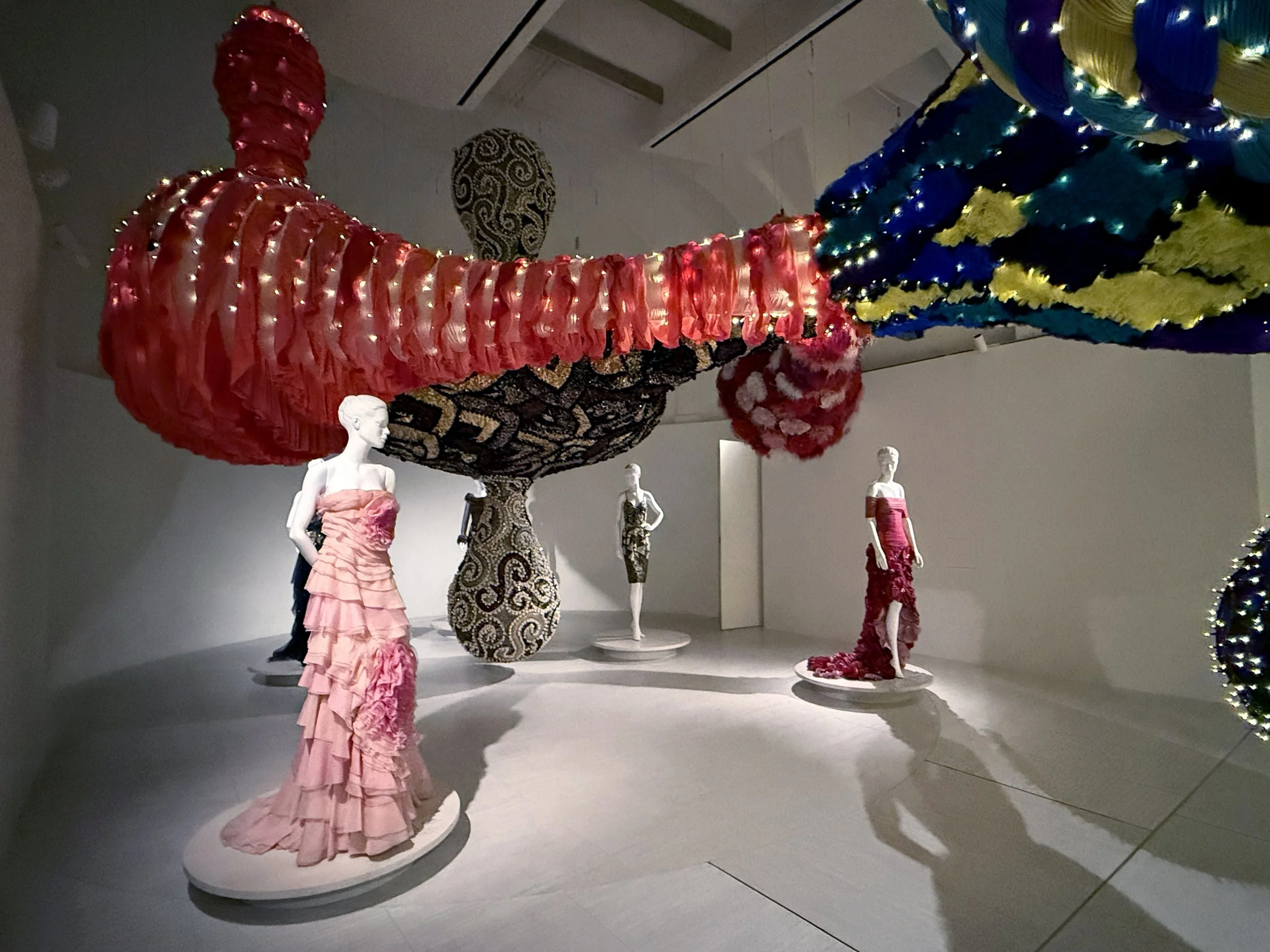
“Mr. Valentino believes deeply in beauty – and so do I,” Vasconcelos says, “The exhibition is a dialogue. My work and Valentino Garavani’s speak to each other until they converge in a final, almost suspended moment.”
Around this central work, Vasconcelos’s sculptures engage with specific moments from Valentino’s archive. Venus, The Painting from the Crochet Paintings series reframes textile as a pictorial surface, drawing on a Josef Hoffmann motif used in Valentino Haute Couture Fall–Winter 1989–90. Strangers in the Night addresses female archetypes shaped by patriarchal culture, while Full Steam Ahead (Red) #1—a mechanical lotus assembled from ironing irons—returns to the idea of transformation through repetition and labour. Each appears alongside corsets, embroidered jackets and sharply tailored silhouettes from Valentino.
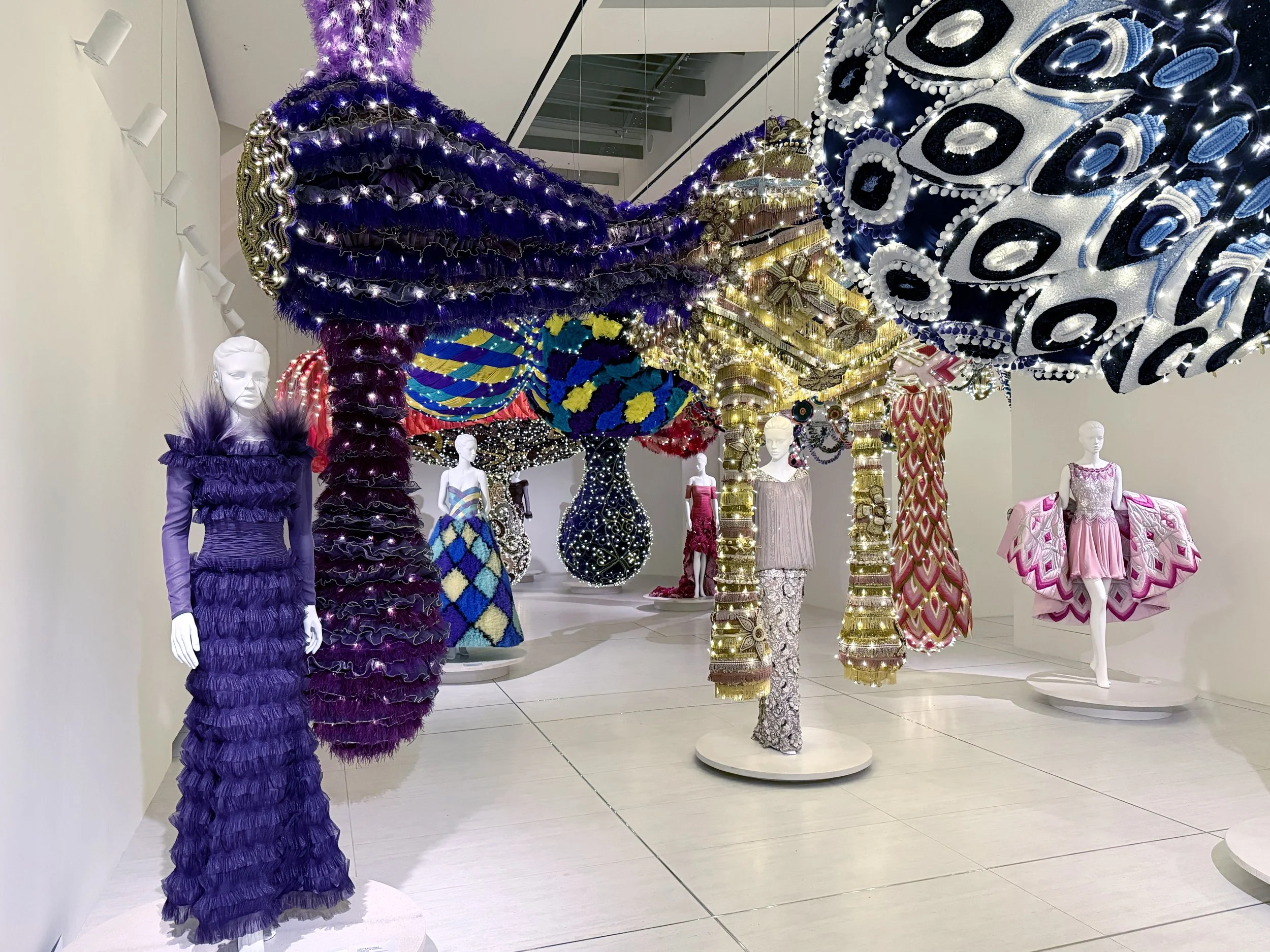


In Marilyn, pots, pans and lids are assembled into monumental high-heeled shoes. Positioned next to Valentino’s gowns, the work is unapologetically literal, turning kitchen equipment into an exaggerated symbol of femininity while keeping its material origins in plain view.

The exhibition extends into the city. At Piazza Mignanelli, I’ll Be Your Mirror takes the form of a large mirrored mask made from baroque bronze mouldings and hundreds of overlapping mirrors, turning spectators into temporary participants through reflection. At Terrazza del Pincio, Solitaire arranges golden rings and crystal glasses into the outline of an oversized diamond ring.
For Valentino Garavani and Giancarlo Giammetti, the project reflects the Foundation’s broader aims. “VENUS was born from the desire to celebrate creativity in all its forms, as a bridge between art, fashion and community,” they explain, emphasising participation and collective authorship as central to the exhibition.
What gives the pairing its weight is the way both practices insist on labour. Vasconcelos foregrounds craft traditionally dismissed as decorative or domestic; Valentino’s archive reveals another form of sustained, meticulous work, embedded in cut, embroidery and finish. Here, neither is softened for the other. They share the space, and the exchange feels grounded rather than ornamental.