From Buckles to Brooches: Men and the Art of Ornament

Brooch and pendant Flos. Titanium, white gold, diamonds, and Brazilian aquamarine
Men’s fashion in the 18th century embraced colour, display, and ornament without hesitation. Buckles set with precious stones adorned shoes and belts; gold chains suspended watches and snuffboxes crafted in enamel or engraved with portraits and coats of arms, often framed by diamonds and other gemstones. Jewellery was neither secondary nor decorative excess—it was part of how men made themselves legible in society.
Over time, masculine ornament became a direct way of signalling who one was and where one belonged. Rings, chains, pins, and insignia marked family lineage, social rank, political allegiance, or military affiliation. Adornment carried authority and identity, encoding personal and collective narratives in metal, stone, and craftsmanship.
The Gentleman – Style and Jewellery for Men, a new exhibition at Palazzo Morando | Costume Moda Immagine, brings this often-overlooked dimension of men’s dress into focus. Through jewellery, garments, and historical documents, the exhibition examines the cultural and symbolic role of masculine ornament, restoring both historical depth and contemporary relevance to a subject too frequently sidelined in fashion history. Each object has been chosen not only for its aesthetic quality, but for what it reveals about the man who wore it and the society he inhabited.
Curated chronologically, the exhibition retraces the evolution of men’s jewellery from the 18th century to the present day, offering a reading of how ideals of masculinity have shifted over time. The early sections focus on an era in which elaborate accessories formed a natural extension of elite male dress. Rings, seal pendants, and gem-set buckles were not simply luxurious embellishments; they conveyed rank, authority, and taste through immediately recognisable visual codes.
The 19th century marked a gradual containment of decorative exuberance. As bourgeois values reshaped masculine ideals, jewellery became more discreet and functional. Cufflinks, tie pins, and watch chains replaced flamboyant ornament, preserving attention to detail while conforming to a sober, rational image of manhood. Jewellery did not disappear; it recalibrated its presence and meaning.
The 20th century introduced a series of tensions. While modernity encouraged simplification and standardisation, certain figures—artists, intellectuals, musicians, and film icons—reclaimed ornament as a form of individual expression. Jewellery re-emerged as a marker of charisma, power, or cultural affiliation, punctuating moments of rupture within otherwise restrained modes of dress.
The contemporary sections reflect a renewed freedom. Designers and artisans propose jewellery that resists fixed definitions, blurring the boundaries between masculine and feminine, between utility and decoration. Iconic houses such as Buccellati, Bulgari, Cartier, and Damiani appear alongside independent creative voices including Cusi di Corso Monforte, Margherita Burgener, Milano Jewels, and Lucilla Giovanninetti. Together, they illustrate how men’s jewellery today moves fluidly between heritage and experimentation.
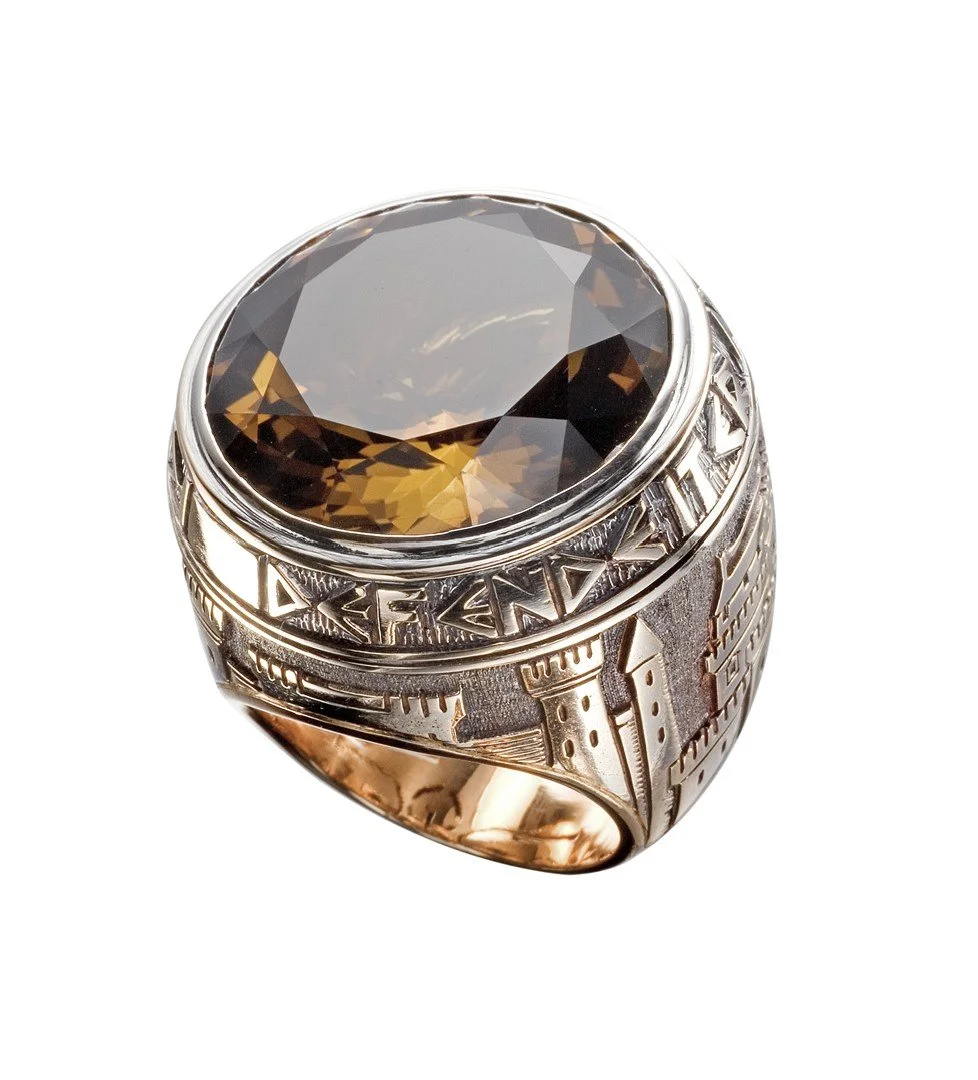

As curator Mara Cappelletti observes, many contemporary jewels have moved beyond gendered distinctions of form, scale, or material. They are conceived to accompany the individual rather than conform to expectation—objects designed to express authenticity, without reference to age, gender, or convention.
Seen across centuries, men’s jewellery emerges not as ornament in the decorative sense, but as a persistent expression of identity. From the assertive display of the 18th century to today’s more personal, fluid interpretations, it remains a quiet yet revealing register of how masculinity has been reimagined over time.