Mossi Traoré at MuCEM: Rewriting Fashion’s Social Contract
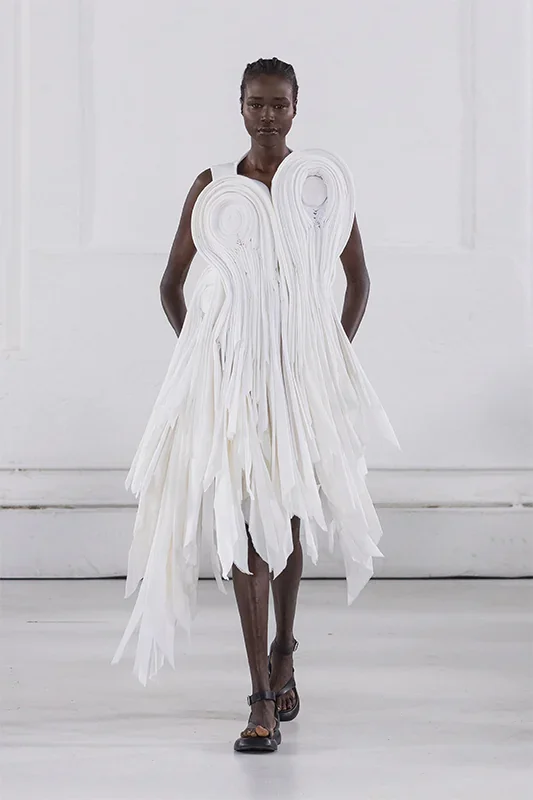
French fashion designer Mossi Traoré has spent the past decade showing — quietly, consistently — that couture can hold more than beauty. In his hands, it becomes a way to preserve techniques, pass on knowledge, and give space to stories fashion often overlooks. Next spring, MuCEM in Marseille will give him the room to make that case on a new scale. Mossi: La Mode ensemble, opening 20 May 2026, will be the first museum exhibition devoted entirely to his work, arriving at a moment when both fashion and ethnography are reconsidering how objects carry meaning.
The show will bring together nearly 150 pieces, some drawn from Traoré’s collections and others created specifically for the occasion, placed in dialogue with garments, textiles, and everyday tools from MuCEM’s archives. Not everything will be kept behind a barrier; certain materials will be available to touch, and video and sound installations will fold visitors into the act of making. The museum has described the exhibition as immersive, though what seems more striking is the intention: to let fashion breathe as a lived practice rather than a preserved specimen.
Traoré’s path helps explain why this framing matters. Born in Paris in 1985 to Malian parents and raised in Villiers-sur-Marne, he didn’t inherit an atelier or a lineage. After studying at Mod’Art and working backstage at the Paris Opera, he launched his label in 2017. But it was the founding of Les Ateliers Alix in 2015 that truly set his course. The school teaches haute-couture techniques — embroidery, tailoring, the disciplined architecture of construction — to students who rarely gain access to such training. It isn’t outreach attached to a luxury brand; it is the core of his practice, craft passed hand to hand.
Against this backdrop, MuCEM’s curatorial approach feels especially pointed. The exhibition will not isolate Traoré’s silhouettes as autonomous objects but position them within the museum’s holdings of traditional dress and material culture. The connections are likely to emerge in small, telling encounters — a pleat mirroring a fold in a heritage textile, a shared method of joining fabric, a motif carried through time. By staging these proximities, the museum invites viewers to see contemporary couture as continuity rather than departure.
The title — La Mode ensemble, fashion together — signals the shift. Instead of centring the lone author, the exhibition will foreground collective practice: the teachers at Les Ateliers Alix, the artisans behind historical textiles, the communities whose techniques endure even without attribution. The show will propose a version of fashion where the making is inseparable from the makers.
As fashion grapples with questions of authorship, appropriation, and the fate of handwork, Traoré’s contribution feels unusually grounded. He builds structures that let people learn, and then he builds clothes. MuCEM’s exhibition will give that approach a broader frame — one that suggests the future of couture may depend not only on preservation, but on participation.
Mossi: La Mode ensemble opens at MuCEM on 20 May 2026.