Jean-Charles de Castelbajac: Pop Culture in Stitches
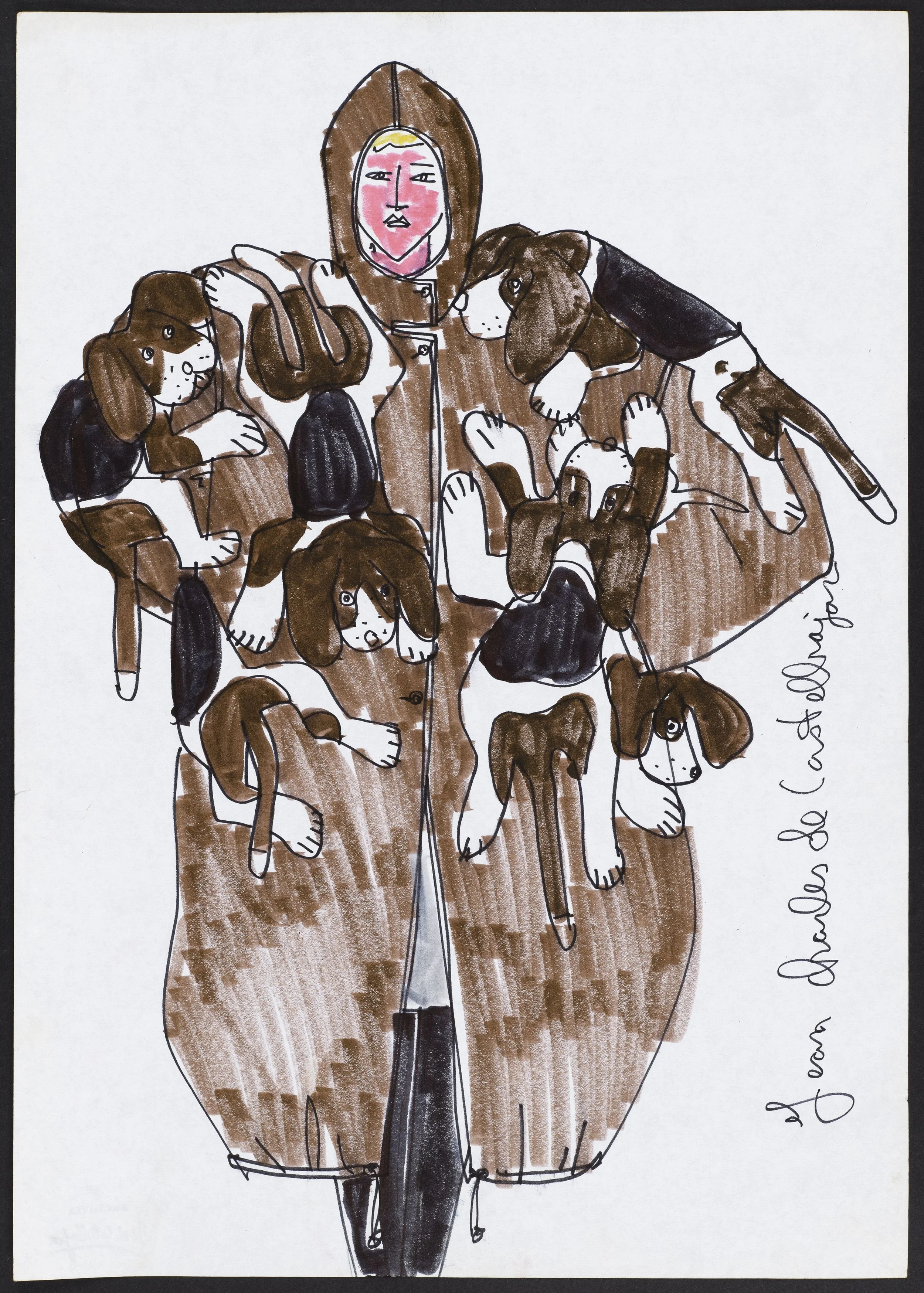
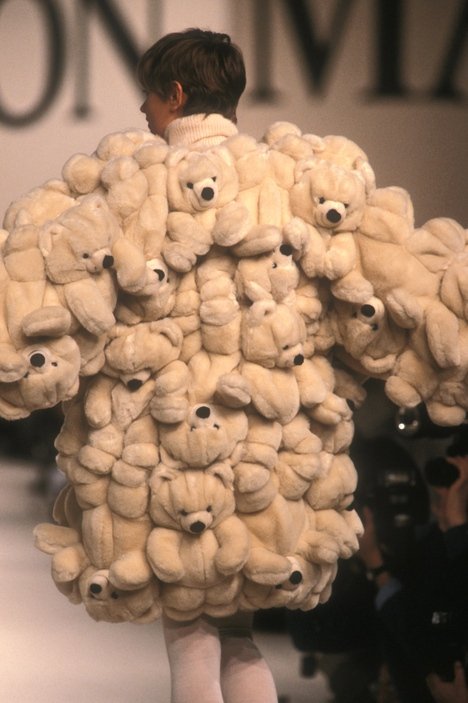
A coat made entirely from teddy bears has become one of Jean-Charles de Castelbajac’s most enduring images. First created in 1988 as a protest against the fur industry, it has been reinterpreted countless times, dressing everyone from Lady Gaga in Kermit to Vanessa Paradis in Snoopy. “My fashion shows were performances, my window displays, installations, my dresses, paintings, my coats, sculptures,” Castelbajac says. “Everything has always been connected.”
It is this spirit of transformation—of turning the everyday into something theatrical and unexpected—that threads through a career spanning six decades. Born in Casablanca in 1949 and raised in France, Castelbajac’s early years left him attuned to improvisation. His first coat, fashioned from a boarding school blanket in 1968, was more than a practical garment: it was a manifesto of resourcefulness and self-expression, an early signal of the playful inventiveness that would come to define his work.
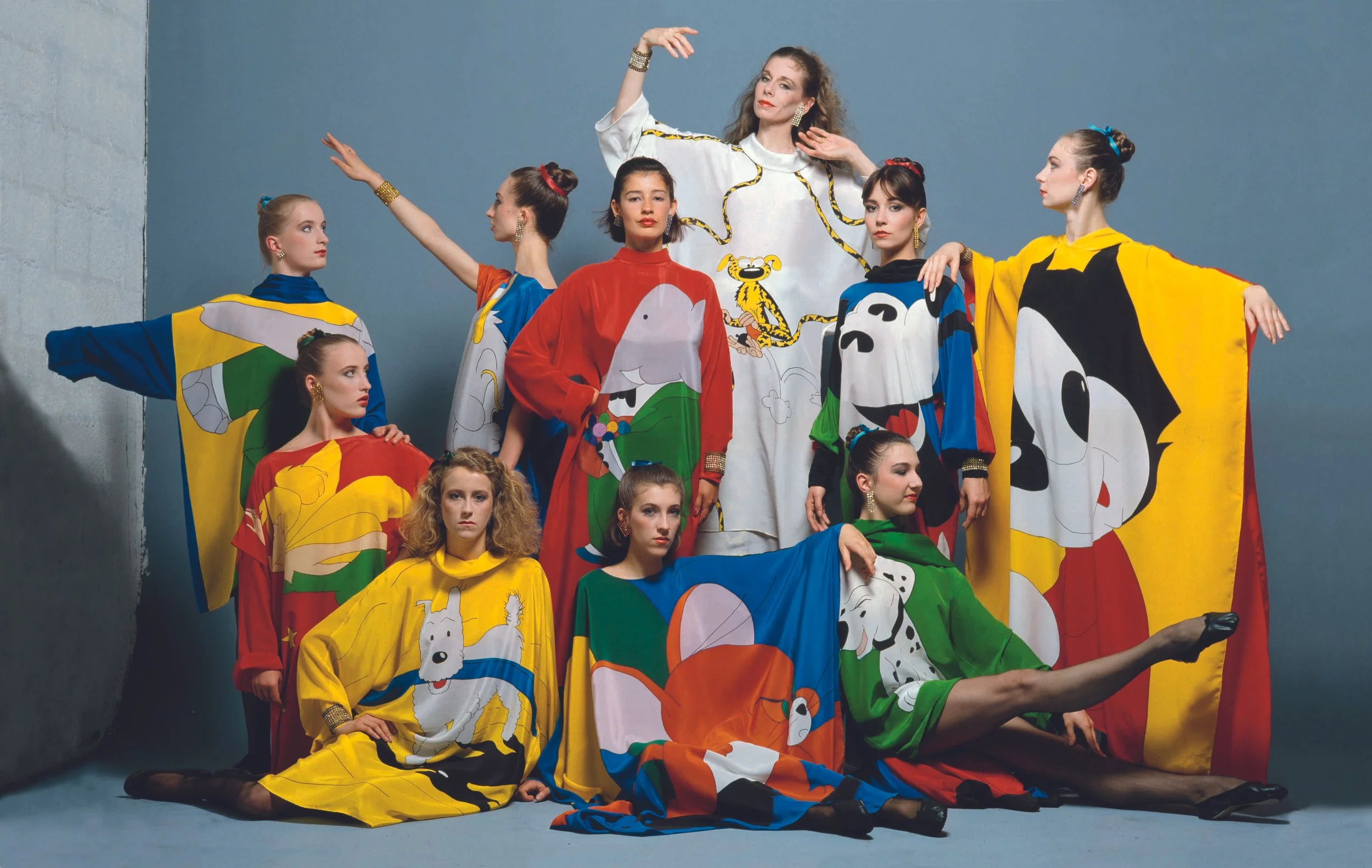
Bettina Rheims, Ghislaine Thesmar et les danseuses du ballet de l'Opéra de Paris, Spring-Summer 1982, “Homage to Comic Books” collection © Bettina Rheims / Adagp, Paris, 2025
The upcoming retrospective, Jean-Charles de Castelbajac: Imagination at Work, opening 12 December 2025 at Les Abattoirs in Toulouse, gathers nearly 300 works across clothing, design objects, drawings, and photographs. Curated by Lauriane Gricourt and Julien Michel, the exhibition traces the designer’s experiments with materials, text, colour, and form, highlighting the unusual pairings and visual puns that have long been his signature.
From the start, Castelbajac worked with what he calls “modest materials, natural weaving with a rough appearance, with uncertain origins, sometimes from textile waste.” Mops, shower curtains, and SNCF bags were all enlisted in his early creations, turning the ordinary into something surprising, tactile, and playful. Later, garments embroidered with poetry by Jean Cocteau, Robert Malaval, and Simone de Beauvoir allowed wearers to “sleep in a poem,” another demonstration of his instinct to fuse art and fashion.
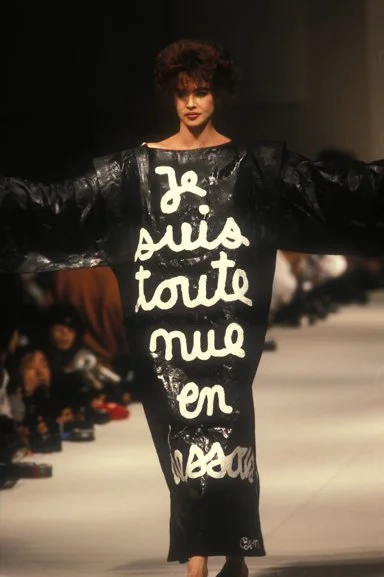
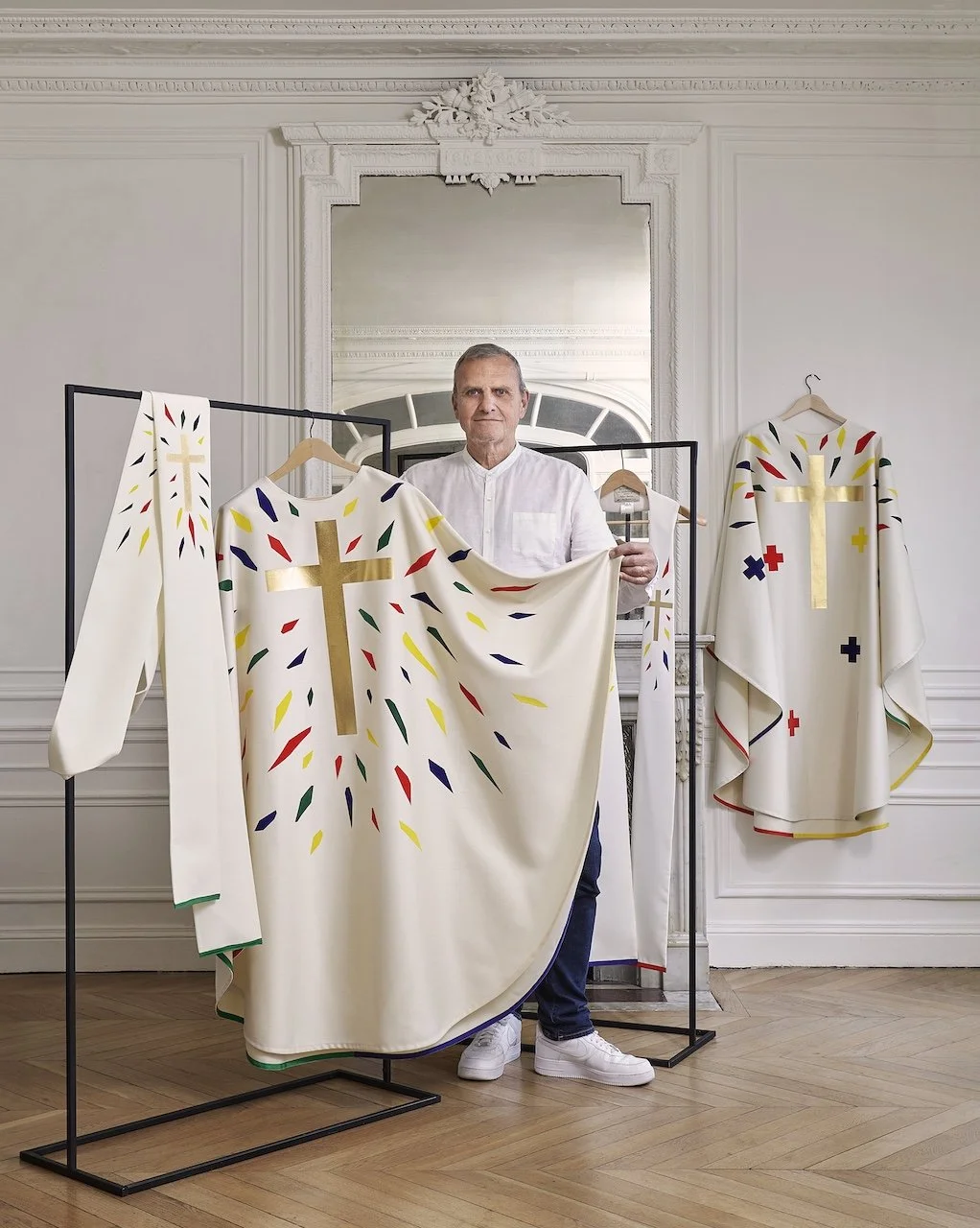
Jean-Charles de Castelbajac and the para ments designed for the reopening of the Notre-Dame Cathedral in Paris, 2024 © Philippe Garci
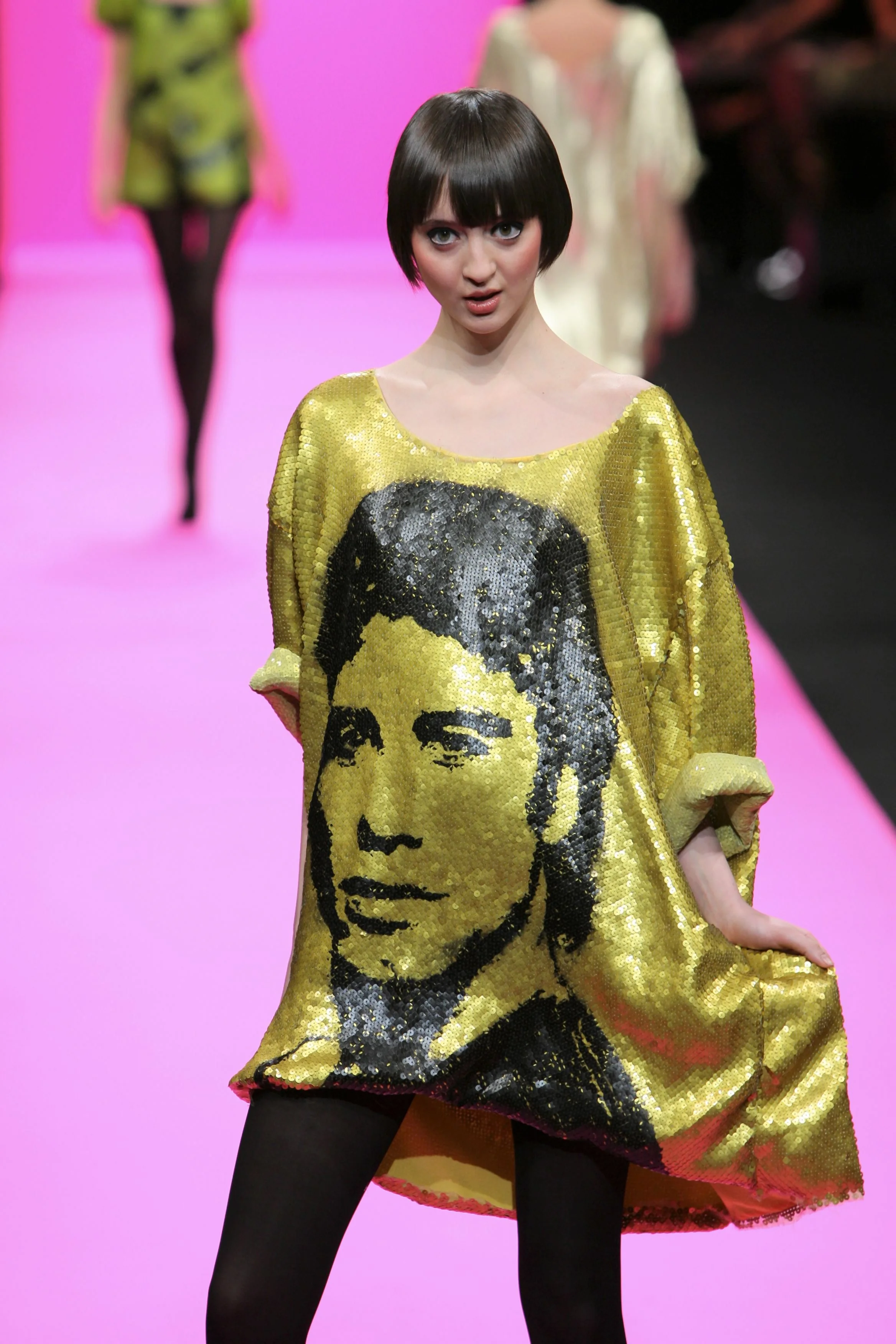
Accumulation pieces—coats constructed entirely from teddy bears, gloves, or even pasta—revealed his sculptural side. “Some pieces were created to protest, some for joy,” he reflects. The teddy bear coat, in particular, combines both impulses: a critique of consumer habits and a whimsical celebration of childhood objects elevated to the monumental. Similarly, his translation of medieval heraldry into street culture, through portrait-dresses of Muhammad Ali or Marilyn Monroe, reframes pop icons with almost ceremonial significance, while his pioneering cartoon sweaters at ICEBERG introduced playful irreverence into high-end knitwear.
Colour has always been central to Castelbajac’s vocabulary. “From 1980 I began to employ the primary colours—red, blue, yellow—as banners of pop culture, but also logos, cartoons, and slogans, in a kind of contemporary response to my passion for medieval heraldry and history,” he explains. This chromatic consistency links his disparate works—from liturgical vestments designed for Pope John Paul II’s 1997 World Youth Days and the 2024 Notre-Dame Cathedral reopening to his more playful streetwear pieces—giving them a recognisable, unmistakable signature.
Collage represents another strand of experimentation. “The drawn line has disappeared,” Castelbajac notes. “There is no longer a boundary between my creative act and the spaces I take over.” His recent drawings and cut-paper works continue to investigate form and material, reflecting the same curiosity that informs his fashion, furniture, and collaborations with Pierre Frey, Palace Skateboards, and Hall.Haus.
Loans from institutions including the Musée des Arts décoratifs, Palais Galliera, MUDE Lisbon, Max Mara, and Benetton Group make this retrospective one of the most comprehensive surveys of Castelbajac’s career to date. While the exhibition is organised thematically, it reads as a career-long conversation with his own work: a dialogue between play and seriousness, pop and spirituality, whimsy and craft.
Jean-Charles de Castelbajac: Imagination at Work opens 12 December 2025 at Les Abattoirs, Toulouse. The show runs through 23 August 2026, inviting visitors to explore a world in which everyday objects, colour, and imagination collide.